
"Binary Trees" - A Musical Journey
Published 27 March 2016 · Last updated 4 September 2026 · Author: Franck Martin
Electronic Music
I really liked the album "Oxygene" from Jean-Michel Jarre. This was my first encounter with Electronic Music. As he stated "In my music, only the instruments are electronic", which reflects a classical rhythm structure for a research on sound. Music Concrète, seems to me more the exploration of sounds than rhythm. There are other forms of electronic music, forms that do away with the classic rhythms or even scales. When I studied in Marseille, I had friends at the Centre National de Recherche Scientifique (CNRS) in acoustics and at other Music Research groups, and went to listen to some of their creations.
Recently a documentary, "I Dream of Wires", explained the west coast vs east coast musical approach. Moog vs Buchla on musical instruments, while my influence on music style is more European.
Listening to Morton Subotnick "Silver Apples of the moon", requires to have already taken a journey in Electronic music. It is not a harder form of music, but it requires previous familiarity with such sounds. For instance, the last album from David Bowie, with lot of experimental Jazz with its strange rhythms, makes it a good bridge between the classic and the "experimental".
Instruments
Electronic instruments used to cost a lot. Even in the 80's when the Yamaha DX7 and Korg M1 came, they were affordable but still expensive. At least they did not cost 10's of thousands of dollars like a Modular Moog. Each instrument had its own sound, and I could recognize, then, when a band was using a DX7. It was electronic and at the same time very limited, as many bands were using the same presets. It was refreshing when a band was not using a DX7...
The revival of modular synthesis and the Eurorack system, spearheaded by Doepfer, and the power of today's computing, means it is easier to produce music. Applications like GarageBand, Logic Pro X, Ableton Live and ProTools, gives you a full music studio on your laptop or even tablet.
The AniMoog and more recently Audulus3, gives you a very complex synthesizer on the go, on your tablet.
On the Go
I started to play with GarageBand, putting some Apple Loops together, mixing them and learnt the tools. I made, like, 8 or 16 bars music samples. Then I got Logic Pro and then Logic Pro X, exported the music from Garage Band and started to work the mix, extending it to full length songs, of about 3 minutes. As I progressed, I looked for tutorials on music production and music theory. Luckily I have access to Safari book online and Lynda. I learnt about plugins, reverb, echo, compression, equalizer, etc.. I learnt more about music theory, I had some basics, like how to read a score, but still I have not converted well from "Do Re Mi Fa So La Si Do" to "C D E F G A B C" as well as understanding music scales, major and minors and what have not... I could put a song together on a plane, in an hotel room, then bring it back home and develop it. I had a few songs, mainly noise, but still. I put them in a playlist called "Binary Trees" but really what to do with them?
Distribution
It seemed people gravitate unto two free services, SoundCloud and BandCamp. SoundCloud is more geared towards streaming music as a social network, while BandCamp is more like a classical music store. Each requires effort to bring people to your song to listen to it. The SoundCloud interface is not suitable for discovery, or to play music from people I follow. I discovered late that there are groups on SoundCloud where you can put your songs, which will get a bit more listeners.
San Francisco
While doing all this, I discovered the documentary "I dream of Wires". It got me interested in Modular Synthesis. I discovered this shop, RobotSpeak, a hole in the ground, nearly, but with a very good vibe, in the Lower Haight. Lower Haight, is like the famous upper Haight, less the tourists, I like to say.
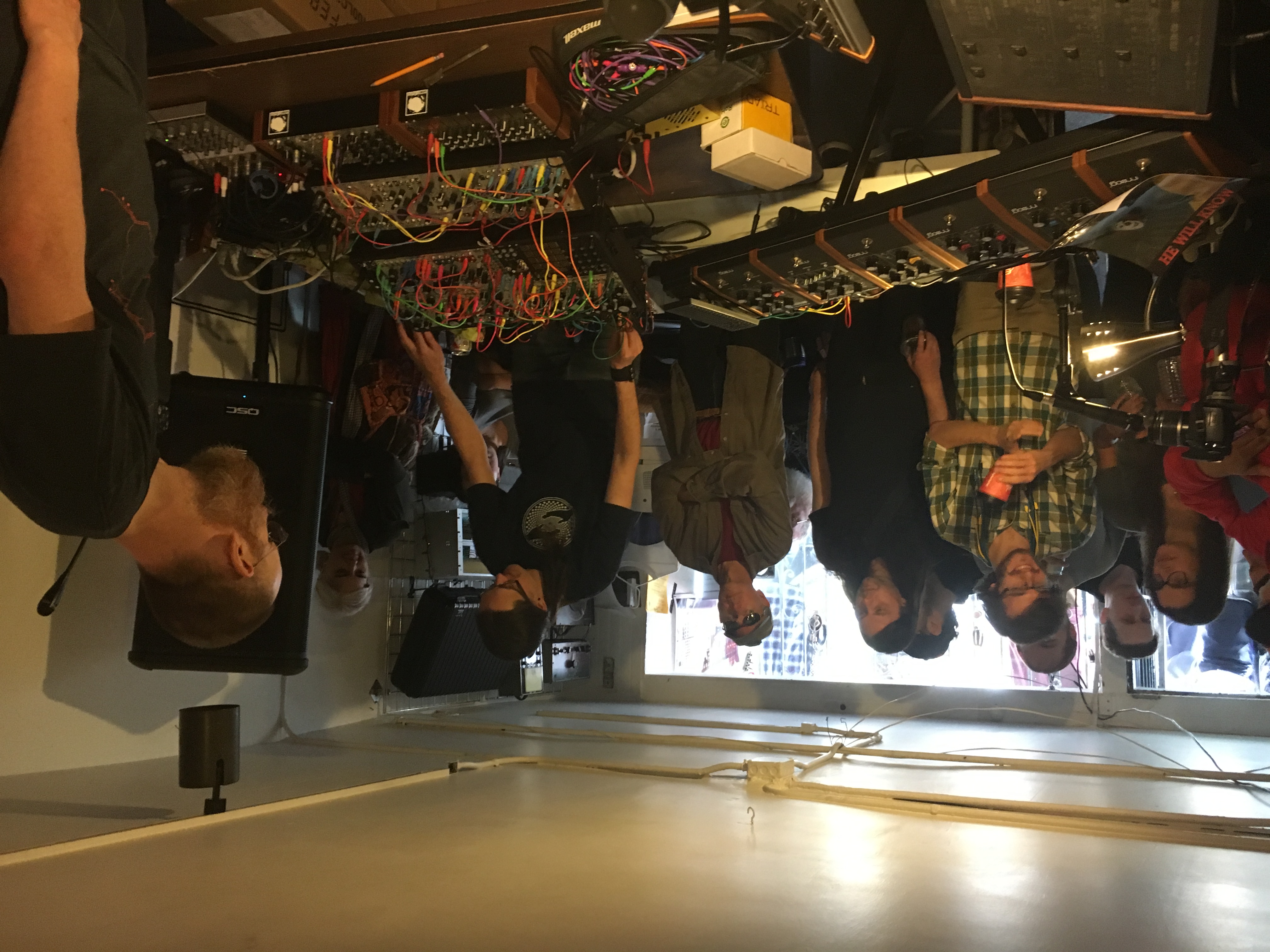
Once a month, on the 3rd Saturday, the owner Steve, invites through "the Church of the Super Serge", named after Serge Modular instruments, local artists to play electronic music. RobotSpeak has been there for ages, it has interesting memorabilia. Once a year there are also bigger events, where manufacturers of modular and Electronic equipments come to present their wares and at the same time play. Next door is a small Vinyl Store and across the street Memphis BBQ...
Local Artists
I discovered a few local (and not so local) people. In no particular order and styles vary largely.
- Bleie
- JDN
- Bardo:Basho
- TypeB
- Sarah Thompson 29
The Church of Super Serge
Here is what a Saturday looks like:
Music Production and Promotion
From an Internet perspective, this is also interesting. You may have heard Artists complaining that they are getting less and less money from their work, due to the increase of piracy, online stores and streaming services.
It seems to me a lot of money goes to the 1% of artists while the thousands of local bands are struggling to make ends meet. At the same time, there are stories of people succeeding by having a strong online presence, without having managers, producers, marketing teams.
Then I heard of this book "The Song Machine" by John Seabrook in "The Economist":
“The Song Machine”, a history of the past 20 years of pop music, takes for granted two assumptions, both convincingly demonstrated via a highly engaging narrative. The most basic is that modern “earworm” pop is a high art form, as worthy of appreciation as any other: he calls Kelly Clarkson’s “Since U Been Gone” “magnificent”, for example, and the “hooks” (catchy, repeated snippets of melody) in Rihanna’s “Umbrella” are “wonderful” and “lovely”. The second is that the public unfairly dismisses such masterpieces, because its expectations of the creative process were set during the rock ’n’ roll era, when singer-songwriters were the norm. In fact, the 1960s and 1970s were a historical aberration, and what may seem like a soulless new wave of industrial music production is a return to the “hit factories” of years gone by.
What is interesting in this book is that modern pop was initiated by a Swedish producer, who did not know music composition but could put loops together, mix and master songs that are catchy, Denniz Pop. Many of today's hits are coming from the Swedish tradition of music production. This book shows that the components of a songs are handled by different professional teams. The artist being the person with character that can project a song and emotions to an audience. More a performer, I would say. It implies that the performer has to be on the road promoting the song while a team back at home is working on the next hit.
One particular interesting extract is when a team of writers, musicians, singers were conveyed for a week to create the next hit for Rihanna. In the morning about 10 teams of 3 people would be formed to create 4 songs in a day. At the end of the day, everyone would listen to the results, and based on the feedback the producer would form the teams for the next day, until a hit emerges.
What I learnt, is that it takes about 3 times to listen to a song, before the listener becomes familiar with the song. To achieve this, you either make sure the song is repeated several times on the radio during the day, or that the song repeats itself, or both...
This is a big industry, nobody is sure how much of a hit it will be, but they know if it will be a hit that they can promote. A lot of money is not related in to making the song but in getting it to people's ears.
In some ways it makes me think of the tech industry. The Label owners are the VCs looking to invest in the next hit, the producers are the CEOs/Founders that have the song, and then the Talent are the engineers. The marketing department is busy getting all of this out to people.
Fortunately as Denniz Pop says it: "Sometimes you have to let art win". See the release of David Bowie "The next day" which was released on iTunes with no announcement or marketing...
Play and learn
So back to my modest experience,
“Binary Trees” is, for me, like a learning platform to understand music production, distribution and promotion. This started more like doing music production as the first songs are mainly Apple loops, then slowly going into composition as I added sounds from pseudo-instruments to real instruments (BandCamp, Animoog, Moog Voyager, Modular Synth,..). This is a learning platform, and I’m still learning, but when I reached about 12 songs, I thought I would put it all together in an album and see what it takes to distribute it and promote it. This is far from ground breaking music, or the latest pop hit. May be one or two stars, if I’m nice with myself, but I’m keen on positive feedback (to learn more) and on getting supported.
Promotion
I have my own web site, peachymango.org but I created a band page on Facebook. I invited all my friends and uploaded links to my songs on SoundCloud or BandCamp. It attracted a few listening hits. Quickly Facebook suggested I should promote the posts or the page. It seems $5 a day seemed reasonable. I tried a few demographics. I discovered that you get a lot of page likes when you promote to demographics that are not used to Facebook Advertisement. If I target the USA I would get like 10 new likes in a day, but If I targeted countries in the Pacific Islands I would get like 100's in a day.
I checked some of the profiles, and they do not seem to be fake, however despite the fact I targeted people that like Electronic music, or Jean Michel Jarre or Vangelis, I'm not sure they are a very engaged demographic, based on the likes I got.
I found out it is best to share the posts in specialized groups like Eurorack Synthesizers and Electronic Music, to get people to view the posts.
Facebook is a visual platform. You can upload text, photos, or videos, but you can't upload music. Even a post with links to SoundCloud or BandCamp does not get to people's wall the way a post with text, photos or videos would do. You cannot upload music, you need to put it in a video, but then there are no cues to turn on the sound...
Distribution
May be the music needs to be where people go and get their music. The music stores and the streaming apps. Or I could do better music, that's another story, a longer and more hard working one. I'm interested to learn the music business, a bit like when John Seabrook wondered where the hits, his son liked, were coming from...
So based on the recommendations on a very good article from Ari Herstand, I went for DistroKid. CDBaby and TuneCore seemed great too, but they had been acquired and I felt I would go for a more startup/agile outfit. I uploaded all the songs on 21st March 2016 (Spring day) as well as the album cover and within a few hours the album was on iTunes. It took an extra day to see it on Google Play, then another day on Amazon, and finally about 4 days to get it on Spotify. It is still been released by other stores, but I think with these four I cater for much, and now I’m spending some time to let it know...
In your music store!
Overall, the cost with all options is around $50 and it is now everywhere in people’s favorite stores. I had it before on Soundcloud or BandCamp, or even my own website, but these are dedicated communities, and requires a level of effort for people to get there to listen to something and then more effort to download the music. I learnt about friction less marketing, so it sounded evident that it needed to be where people usually go. I also hope a bit of cross referencing will happen as many of these stores suggest other songs based on the listener preferences.
To recover my costs ($50), I would need about 10 people to buy the album or 100 people to buy a song or to get 10,000 listening on streaming. DistroKid does not take money on sales, but the store usually does, between 20 to 30% of the sales.I do hope 10 people are willing to spend about 9$ on the album.
Just as a data point, to live from the music, everything needs to be multiplied by a 300-400 or about 4,000 people buying the album. It takes about a year to make an album, sometimes two, unknown, indie or rock star. If you want to add some promotion then say 5,000 people need to buy the album.
And finally the Call to Action (CTA)
I don’t need to live from this music, but I’d appreciate any support.
Download the music, write a review, put some stars, follow me or simply play the album helps to get it more visible.
I follow the stats, so any “+1” encourages me to make more noise... And the more noise I make, the more I learn about the musical arts and the music business.
So thank you for reading that far, and I soon hope to read your positive criticism/feedback/suggestions or questions... And if you are in a similar journey, I'd like to hear from you...